admin
admin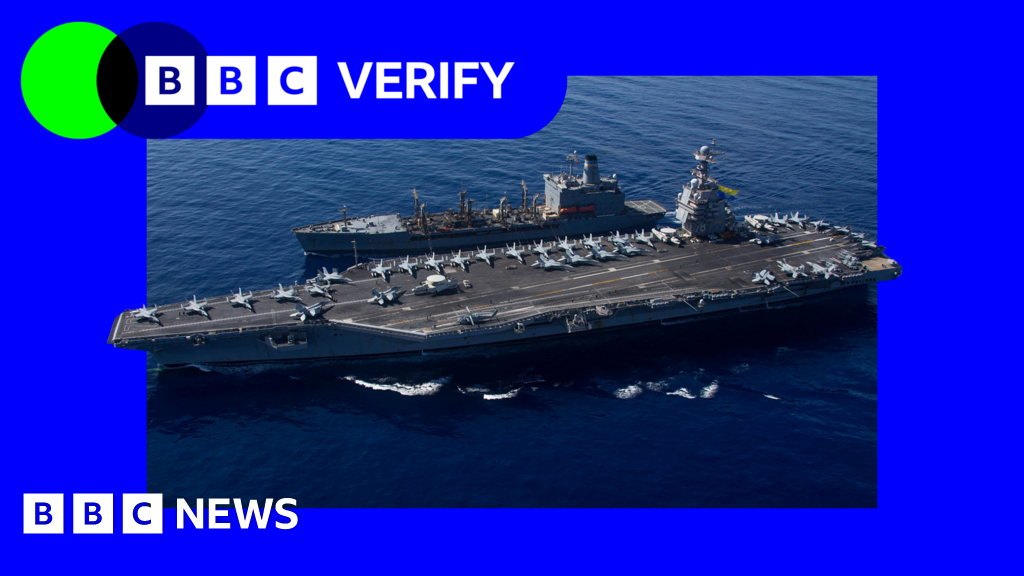
Jake Horton, Barbara Metzler & Joshua CheethamBBC Verify
Satellite imagery shows at least six US military vessels have been operating in the Caribbean over the past week, as tensions between the US and Venezuela escalate.
BBC Verify believes a further five vessels are also in the region as part of the US build-up.
It follows a series of US air strikes against alleged drug boats in the Caribbean and eastern Pacific in recent months, which the Trump administration says are necessary to stem the flow of drugs.
The build-up involves thousands of troops and the world’s largest warship being positioned within striking distance of Venezuela, and has sparked speculation about the potential for some kind of military action.
Where are US warships?
The build-up in the Caribbean began in August with the deployment of air and naval forces, including a nuclear-powered submarine and spy planes, according to US officials.
It now includes a range of aircraft carriers, guided-missile destroyers, and amphibious assault ships capable of landing thousands of troops.
Analysis of satellite images has made it possible to identify at least six military vessels in the region over the past week.
The largest is the aircraft carrier USS Gerald R Ford, which was about 75 miles (120km) south of the Dominican Republic on 27 November. This is about 435 miles (700km) from the Venezuelan coast.
It had previously been spotted further east in mid-November about 125 miles (201km) south of Puerto Rico, a US territory in the Caribbean, and then sailed south before heading towards the Dominican Republic.
The ship, which travels in a strike group with other supporting vessels, is more than 330 metres (1,100 feet) long.
BBC Verify has also seen several other vessels in close proximity to the Gerald R Ford.
And we have also identified some other US vessels in the Caribbean.
These include the MV Ocean Trader, a special operations command vessel, spotted on satellite imagery on 25 November between Puerto Rico and the Dominican Republic, and a USS Antonio class vessel, which is a type of amphibious transport ship, seen on 27 November, 65 miles (90km) south of Puerto Rico.
The closest vessel to Venezuela we saw was a fuel resupply ship seen on 27 November, 298 miles (480km) north of the Venezuelan coast.
Satellite images also showed a further five vessels in the Caribbean area, but we couldn’t definitively confirm their identities.
Our analysis also shows that in one case, a naval vessel, previously tracked in the Caribbean, has returned to the US, and is now in Key West, Florida.
We do not know the reason for these movements, but they may have been to resupply.
What about planes?
The US has also deployed F-35 fighter jets to its bases in the Caribbean, and has flown bombers and spy planes over the region.
BBC Verify used flight tracking data to identify four US military aircraft flying near Venezuela on 20 and 21 November.
A US B-52 long-range bomber briefly appeared on flight tracking website Flightradar24 off Guyana – Venezuela’s eastern neighbour – at around 23:45 GMT (19:45 local time) on 20 November.
The data shows the bomber – call sign TIMEX11 – departed from the US state of North Dakota that afternoon and landed back there the following morning.
A US Air Force surveillance aircraft – call sign ALBUS39 – appeared on flight-tracking data just after 22:00 GMT (18:00 local time) on 20 November, flying for about two hours near the eastern coast of Venezuela.
Around a similar time a US Navy Super Hornet fighter jet – call sign FELIX11 – was seen circling off the western coast.
And a US Air Force refuelling tanker – call sign PYRO33 – was also over the southern Caribbean around 01:30 GMT (21:30 local time) on 21 November. It then stopped broadcasting its location until it was later seen heading north-west.
In October, three B-52 bombers took off from an airbase in Louisiana and circled off the coast of Venezuela before returning, according to flight tracking data from FlightRadar24.
And last month tracking data shows several P-8 Poseidon reconnaissance aircrafts flew south over the Caribbean from a US naval base in Florida.
Experts say these flights suggest the US is trying to gather military intelligence from the region.
“We see activity by P-8As around the world anywhere the US Navy has an interest in boosting its marine domain awareness,” says Henry Ziemer, an Americas specialist at the Center for Strategic and International Studies (CSIS).
US President Donald Trump has also acknowledged that he authorised the CIA to conduct covert action in Venezuela, although the scope of what that might mean remains highly classified.
Is the US preparing to attack Venezuela?
The build-up has prompted concerns that the US is preparing to directly target Venezuela, or potentially try to topple the socialist government of President Nicolás Maduro.
“The level of forces, and the fact that they are plainly not tailored for the purpose of pure drug interdiction has raised suspicions the US may be heading towards war with Venezuela,” says Mr Ziemer.
“The escalation risks are significant, but I think that within the Trump Administration there is still considerable debate over what will come next,” he adds.
Asked if the US was going to war against Venezuela, Trump told CBS’ 60 Minutes on 3 November: “I doubt it… But they’ve been treating us very badly.”
However, on 29 November, President Trump said that the airspace above and around Venezuela should be considered “closed in its entirety“.
The Venezuelan government has accused the US of stoking tensions in the region, with the aim of toppling the government.
In response in November they declared a “massive mobilisation” of troops, which saw 200,000 personnel sent across the country.
“Overall, I believe the pace of strikes against targets at sea will increase in the near future, while the United States tries to make up its mind about whether it can strike inside Venezuela,” says Mr Ziemer.
How many air strikes on boats have there been so far?
Since early September, US forces have carried out at least 21 separate strikes, in international waters both in the Caribbean and in the eastern Pacific, according to the BBC’s US partner, CBS News.
Collectively, at least 83 people have been killed, according to statements from US officials.
While US forces have not publicly identified the people killed, they have alleged they were all “narco-terrorists”.
An investigation from the Associated Press reported that several Venezuelan nationals killed in the strikes were low-level traffickers driven by poverty to a life of crime, as well as at least one local crime boss.
Why is the US conducting strikes?
Trump and members of his administration have justified the strikes as a necessary to stem the flow of narcotics from Latin America to the US.
In a statement, Defence Secretary Pete Hegseth said that the campaign – which has been officially named Operation Southern Spear – is aimed at removing “narco-terrorists from our hemisphere” and securing the US from “the drugs that are killing our people”.
In some cases, US officials have claimed that the targets were tied to Tren de Aragua, a Venezuelan gang designated as a foreign terrorist organisation by the Trump administration at the start of the year.
But little information about the targets or what drug trafficking organisations they allegedly belonged to has been officially released by the Pentagon.
The Trump administration has insisted that the strikes are legal, justifying them as a necessary self-defence measure aimed at saving American lives.
But some legal experts have said the strikes could be illegal and violate international law by targeting civilians, with no due process afforded to the suspects.
Additional reporting by Kumar Malhotra, Tom Edgington and Bernd Debusmann Jr. Graphics by Leo Scutt-Richter.

 narayan