
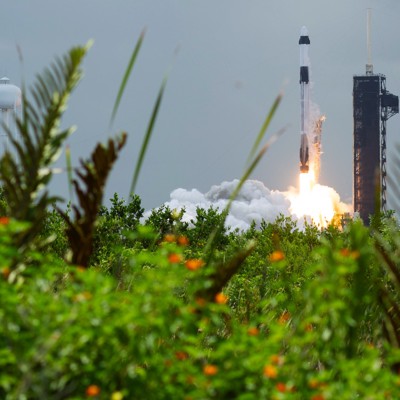
Trump aims to foster space industry by cutting environmental regulation
The U.S. government must reduce environmental and other regulations to make it easier for commercial space companies to launch rockets, expand launch facilities, and perform “novel” space activities, according to a new executive order.
“It is the policy of the United States to enhance American greatness in space by enabling a competitive launch marketplace and substantially increasing commercial space launch cadence and novel space activities by 2030,” says the order, signed Wednesday by President Donald Trump.
Specifically, the order will “eliminate or expedite” environmental reviews for launch and re-entry licenses and permits and establish “exclusions” to the National Environmental Policy Act, or NEPA.
The order would also “reevaluate, amend, or rescind” regulations under the Federal Aviation Authority’s Part 450 rules, which govern safety requirements for launch and re-entry operations but are widely viewed as too restrictive by commercial launch companies.
The push to streamline license and permit approvals comes amid a surge in both national security and commercial launches—so many that they are straining the Space Force’s main launch facilities, Cape Canaveral in Florida and Vandenberg in California
To speed up the “next-generation” of spaceport infrastructure, the order directs the Commerce, Defense, and Transportation departments, along with NASA, to identify any state or local barriers to building spaceports on federal lands that “may be inconsistent with federal law.”
The new policy will benefit Elon Musk’s SpaceX, which has been battling with the FAA for years and views environmental regulations as an obstacle to testing its new mega-rocket Starship. Earlier this year, the FAA grounded Starship for two months after debris fell on the Caribbean islands.
But while the order will help SpaceX in the near-term, it will also clear the way for more launch competitors in the long-term: “This is the space industry overall getting heard,” said Todd Harrison, a senior fellow at the American Enterprise Institute.
The regulatory reform is a “big step in the right direction” and will help the launch and commercial satellite industry keep an edge over other countries, Harrison said.
But Harrison cautioned that the administration still hasn’t staffed the National Space Council, the entity which coordinates space policy across the federal government, so it will be difficult to implement the executive order and coordinate with different departments.
“Commercial space regulatory reform is not going to be a priority for Commerce, Transportation, or Defense unless consistent top-level pressure is applied from the White House,” Harrison said.