
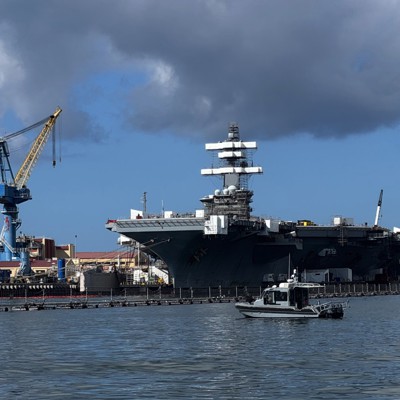
‘Stop trying to control every step’ of shipbuilding, senator tells Navy
The White House wants to speed up shipbuilding, but first, the Navy has to loosen its grip—at least according to one senator.
“The Navy has taken over shipbuilding, I believe, to their detriment,” said Sen. Tim Sheehy, R-Mont., a member of the Senate Armed Services Committee, during a Center for Strategic and International Studies event on Tuesday. “An average naval officer is not a shipbuilding expert. They’re just not…It takes decades to build that institutional knowledge of not just naval architecture, but also knowledge of the industrial base, to effectively build the ship and build it fast and build it right. And the Navy lost that institutional knowledge decades ago.”
Sheehy, a former Navy SEAL, said the Navy must “stop trying to control every step of the process” and be more decisive on what it needs—which will in turn bring down costs and speed up production.
“Stop the change orders, stabilize specs, lock in engineering requirements and then push it out to industry to bid and manage the build of those vessels as fast and cheaply as possible. And we’re going to see quantity go up, price go down, and we’re going to see suppliers coming to the table—we’re going to see a broader supplier base,” Sheehy said. “So, for all the bashing of the big defense primes, of the Big Five—‘They’re bad.’ No, they’re not. They’ve just responded to the reality. The Pentagon has built a landscape and asked them to play by a set of rules. They’ve played by those rules, and those rules have encouraged mass consolidation, very long, drawn-out processes, where the process is the point, not the outcome. And we have to change those incentives to where the outcome is the point, not the process.”
Earlier this year, the White House issued executive orders meant to speed up defense acquisitions and shipbuilding. The Pentagon followed suit with its own directive for buying software. But the Pentagon and Congress have wrestled with acquisition reform for years.
Defense acquisition “has to be lit on fire and destroyed and rebuilt from the ground up,” Sheehy said. “So, it’s more than a radical rethink. We need a revolutionary point of view on this. And if we can fix shipbuilding, I believe that will trickle down to the rest of defense acquisition.”
In recent years, Navy leaders have called for more competition in the shipbuilding sector as a means to reduce production delays and ballooning costs. Some of those changes are already underway as Navy Secretary John Phelan moves to reorganize the service’s drone-acquisition structure.
But while Sheehy stressed the need to welcome the private sector and more startups to manufacturing, Sen. Tim Kaine, D-Va., said the Navy should look to share maintenance and repair work with allies and partners.
“We have to be 100 percent better. And that is not incremental, that is, again, expanding your capacity through creative work with allies and bringing the private sector—and the innovative part of the private sector, not just the incumbent part of the private sector—bringing them in a much more robust way,” Kaine said at the same event Tuesday.
Kaine, who is the SASC’s ranking member on its seapower subcommittee, also pushed for a bigger defense budget to help spur the maritime industrial base, saying the U.S. can’t ask NATO countries to spend 5 percent of their GDP if it’s not doing the same.
“Three percent is about where we are, maybe a little bit north of that. I mean, at a minimum, we need to do what we’re asking other NATO nations to do…where it was five of 34 nations meeting the 2 percent, it’s now 29 of 34. But I like the fact that President [Donald] Trump is now going beyond in saying 2 percent isn’t enough. It should be [5 percent]. Now, we will give you credit for some infrastructure investments. It’s not just weapons platforms. So, we’re slightly opening up the definition,” Kaine said, noting that U.S. infrastructure investments could bring defense spending closer to 5 percent of GDP.
But it’s a complex problem that requires the U.S. and its allies to evaluate and balance competing priorities, such as commerce security in the Red Sea.
“When the Houthis were firing into the Red Sea. I mean, the U.S. is basically paying the entire bill, even though they weren’t firing at U.S. ships. The U.S. is paying the entire bill for protecting commerce through the Red Sea, ships flagged by other nations,” Kaine said. “Obviously, we’re going to defend U.S. military ships, but a lot of what they were firing at was commercial ships from other nations…We have a lot of things we want to do. Are we honest about matching up those aspirations with dollars? But that is why pushing allies to do more and getting closer together with allies is so important.”