
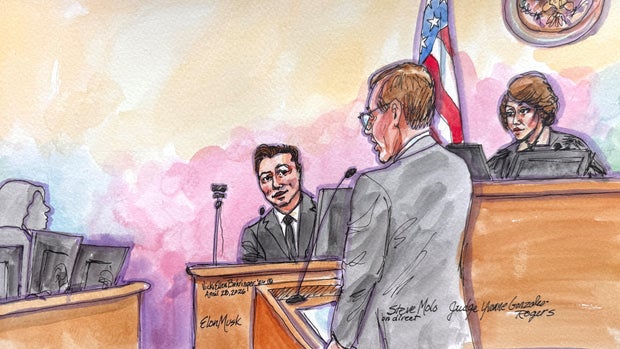
Elon Musk tells court he was a "fool" for funding OpenAI
Elon Musk told a court on Wednesday that he was a “fool” for providing funding to launch ChatGPT maker OpenAI.
Testifying in a case he brought against OpenAI, the billionaire founder of Tesla and SpaceX said he continued to finance OpenAI after receiving assurances from OpenAI CEO Sam Altman that the company would remain a nonprofit. However, Musk said he began to have doubts about the company’s direction and said he later felt betrayed.
Musk alleged in his civil lawsuit that OpenAI, Altman, and OpenAI President Greg Brockman reneged on the AI company’s founding agreement by prioritizing profit over a promise to keep OpenAI as a nonprofit dedicated to human progress.
The trial, playing out in the U.S. District Court for the Northern District of California, started Monday and is expected to last about four weeks.
Vicki Behringer
Musk contributed $38 million in funding to OpenAI from December 2015 through May 2017. The AI company is now valued at more than $85 billion.
Lawyers for OpenAI reject Musk’s allegations, saying that company leaders never promised it would remain a nonprofit forever. The company has argued Musk’s legal challenge is aimed at undercutting OpenAI’s rapid growth and bolstering Musk’s xAI, which he launched in 2023 as a competitor.
Heated cross-examination
During cross-examination, Musk repeatedly pushed back on questions. OpenAI lawyer William Savitt asked about emails Musk wrote before OpenAI’s founding in 2015, including whether it would be better to make it a standard for-profit company and whether tax deductions would apply to his donations to the nonprofit.
“Your questions are not simple,” Musk said. “They are designed to trick me essentially.” Any simple answer, he said, would be misleading the jury.
Judge Yvonne Gonzalez Rogers stepped in, asking Musk to answer whether it’s true or false that OpenAI was formed as a nonprofit in December 2015. Musk said in that case, the answer was yes, but added that it is not always simple, comparing it to asking “have you stopped beating your wife?”
“We are not going to go there,” the judge replied, to laughs in the courtroom.
High stakes
Despite moments of levity, the stakes are high at the trial, which could sway the balance of power in artificial intelligence. Musk’s lawsuit seeks to oust Altman from OpenAI’s board. If Musk wins, it could also derail OpenAI’s plans for an initial public offering.
Musk’s decision to stop funding the company contributed to a bitter falling out between the former allies that’s been evident throughout the trial. On Wednesday, Musk said his views on Altman and his OpenAI cofounders had three phases — from initial excitement to losing confidence to a period in late 2022 when he thought “wait a second, these guys are betraying their promise.”
Lawyers for OpenAI have said Musk sought to control the company for himself.
Musk repeatedly testified that while he initially sought a majority stake in OpenAI and control of four out of seven board seats, this would eventually be diluted when OpenAI grew and gained more shareholders. He compared it to his stake in Tesla, which he said is now around 15% after he initially had a majority stake when the electric car maker was founded over two decades ago.
OpenAI, however, claims there were no assurances that he would eventually relinquish his board majority.