
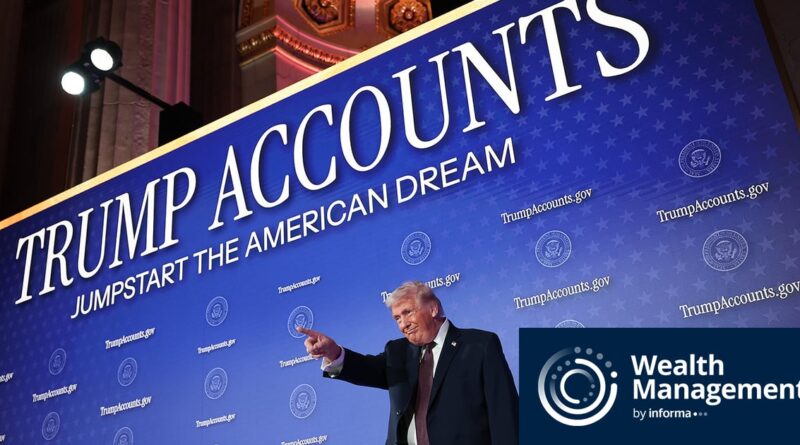
IRS Issues Safe Harbor for Trump Account Contributions
On June 29, 2026, the Internal Revenue Service released Revenue Procedure 2026-25, which provides a transfer tax safe harbor for certain, but not all, contributions to Trump accounts. When the safe harbor contained in Section 4 of this revenue procedure is available, contributions to Trump accounts will be treated as completed gifts that aren’t future interests in property and to which the gift and GST tax annual exclusions apply, thereby dispensing with the need for such taxpayers to file a gift tax return. This is undeniably helpful for those taxpayers within the scope of this safe harbor (and to the IRS, which would otherwise be deluged with potentially several million gift tax returns each year as a result of Trump account contributions). However, it provides disparate treatment for taxable gifts for all other taxpayers and requires donors to Trump accounts that don’t fall within the safe harbor to file a gift tax return to report the contribution to the Trump account as a taxable gift (and potentially also as a transfer subject to GST tax).
Trump Accounts
The One Big Beautiful Bill Act (P.L. 119-21), enacted on July 4, 2025, created “Trump accounts” via new Internal Revenue Code Section 530A. These new tax-advantaged savings accounts are broadly modeled after traditional individual retirement accounts and aim to encourage long-term savings and investment on behalf of American children who haven’t attained age 18 before the close of the calendar year in which an election to open an initial Trump account is made.
Importantly, the account beneficiary for whom a Trump account is established is subject to significant restrictions on the ability to receive distributions from the Trump account during the “growth period,” which is the period ending before Jan. 1 of the calendar year in which the account beneficiary attains age 18. During the growth period, no distributions may be made from a Trump account, except for qualified rollover contributions, a qualified ABLE rollover contribution, distributions of excess contributions and distributions on the death of the account beneficiary.
Relevant Tax Rules
Section 530A is silent concerning the gift and GST tax treatment of a contribution to a Trump account. As the revenue procedure acknowledges, this poses a problem for gift and GST tax purposes.
Absent an exclusion, a gift tax is imposed on the transfer of property by gift. Exclusions from gift tax treatment are described in IRC Section 2503. In particular, Section 2503(b) describes the annual exclusion, which is $10,000 per donor per donee as adjusted for inflation. For gifts made in 2026, the annual exclusion is $19,000 per donor per donee. According to Section 2503(b)(1), the annual exclusion applies only to gifts that are gifts of “a present interest in property.”
In addition, absent an exception, a GST tax is imposed on the transfer of property by gift to a skip person (generally a person assigned two or more generations below the transferor, such as a grandchild). Section 2642(c) provides an exception from the GST tax for gifts that are excludable under Section 2503(b). For gifts made in 2026, the amount potentially protected from the GST tax is $19,000 per donor per donee.
The revenue procedure further provides that gifts of a future interest in property must be reported on a gift tax return because they aren’t eligible for the annual gift tax exclusion. According to the revenue procedure, in FY 2025, the IRS received approximately 300,000 Form 709 gift tax returns. In contrast, because nearly 6 million elections to open Trump accounts have already been received, the number of gift tax returns filed annually could be expected to increase from roughly 300,000 to several million.
The Safe Harbor
Against this backdrop, Rev. Proc. 2026-25 provides a safe harbor for taxpayers under Section 4. To come within the safe harbor, all of the following requirements must be met for a particular calendar year:
-
The taxpayer is an individual;
-
The only taxable gifts made by the taxpayer during the calendar year are cash contributions (in the form of cash, check, money order or electronic funds transfer) to one or more Trump accounts, each made before the calendar year in which the account beneficiary attains age 18;
-
The taxpayer’s total gifts during the calendar year to each individual who’s an account beneficiary, including contributions to that account beneficiary’s Trump account, don’t exceed the annual exclusion amount under Section 2503(b) ($19,000 for 2026);
-
Such contributions to Trump accounts made during the calendar year don’t generate for that calendar year either a gift or GST tax liability, after application of the taxpayer’s remaining applicable credit amount against the gift tax, or remaining GST tax exemption; and
-
Disregarding the Trump account contributions described in item (2) above, no gift tax return is required to be filed, and no gift tax return is otherwise filed, for that calendar year by or on behalf of the taxpayer, whether for GST tax, portability or other purposes.
If each of the foregoing requirements is satisfied, then each Trump account contribution made by the taxpayer during that calendar year will be treated as a completed gift to the account beneficiary that isn’t a future interest in property and to which the annual exclusion applies for purposes of the gift tax, the GST tax and the gift tax reporting. As a result, taxpayers within the scope of Section 4 of this revenue procedure won’t be required to file a gift tax return reporting such contributions.
In contrast, the revenue procedure provides that falling outside the safe harbor of Section 4 will trigger gift tax (and potentially GST tax) reporting obligations on a gift tax return.
Presumably, Treasury and the IRS didn’t believe that it possessed the authority to grant additional relief based on the statutory language of Section 530A. Congress should therefore consider a technical correction to Section 530A to eliminate this disparate treatment.