
Can partner nations help solve the Navy’s shipbuilding woes?
JOINT BASE PEARL HARBOR-HICKAM, Hawaii—Expanding the nation’s shipbuilding capacity and output is an “all-hands-on-deck effort,” the U.S. Navy’s top officer said, adding that he has never before seen such alignment “on the imperative” of making it work by Congress, the administration, the defense secretary, the Navy secretary, and the Navy itself.
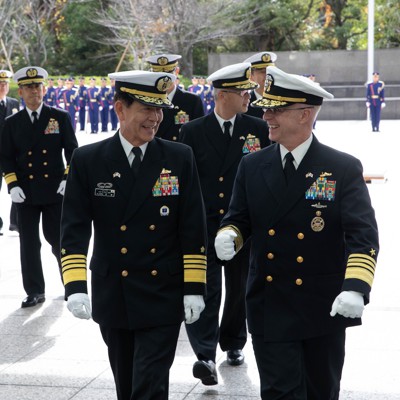
In his first overseas trip as the chief of naval operations, Adm. Daryl Caudle visited South Korea, Japan, and Guam before stopping in Hawaii to tour aging barracks and talk to sailors about quality-of-life issues. In South Korea, Caudle visited HD Hyundai Heavy Industries and Hanwha Ocean shipyards, “to see how can some of our partners bolster our shipbuilding.”
“There’s so much capability there, that we need to partner with them, in the U.S. and in their own country. Same in Japan,” Caudle said Friday. “We’re behind in shipbuilding—that’s atrophied over decades in the United States, and it’s such an important part of our global presence here, our logistics here, our ability to defend ourselves, and have the deterrence mechanism necessary.”
But despite the apparent by-in from leaders across the board, “building ships is not a light switch,” he said. “It takes time to build a high-end ship.”
In the meantime, Caudle said, he must work with the head of Pacific Fleet and Indo-Pacific Command “to ensure that we know how to fight with what we’ve got in existence today.”
Building a well-trained and loyal workforce is another critical piece of the shipbuilding and maintenance puzzle, he said.
“Attrition is a problem. So when I have double-digit attrition, that’s a challenge for me. So we need to get in single-digit attrition, all right? They feel like this is a place they want to work. We want legacy at these shipyards.”
And even if there’s a solid, well-trained workforce, he said, it “doesn’t do any good if they don’t have the parts” which means the Navy must work toward a more resilient supply chain.
Caudle said he chose the Pacific for his first overseas trip in the CNO role because of the “importance of this region,” adding that it is “the most important region…second to defending our homeland.”
The Indo-Pacific “has three of our four primary threats. Obviously, the pacing threat of China’s here. You know, this acute but large and perhaps existential threat given their nuclear capability with Russia, and then North Korea,” he said. “Anyone who’s ever been in my seat is never comfortable with where we stand, because the trajectory of those threats and their emergent technologies and capabilities continue to grow at staggering paces. So we have to sustain our ability to keep up with that.”