
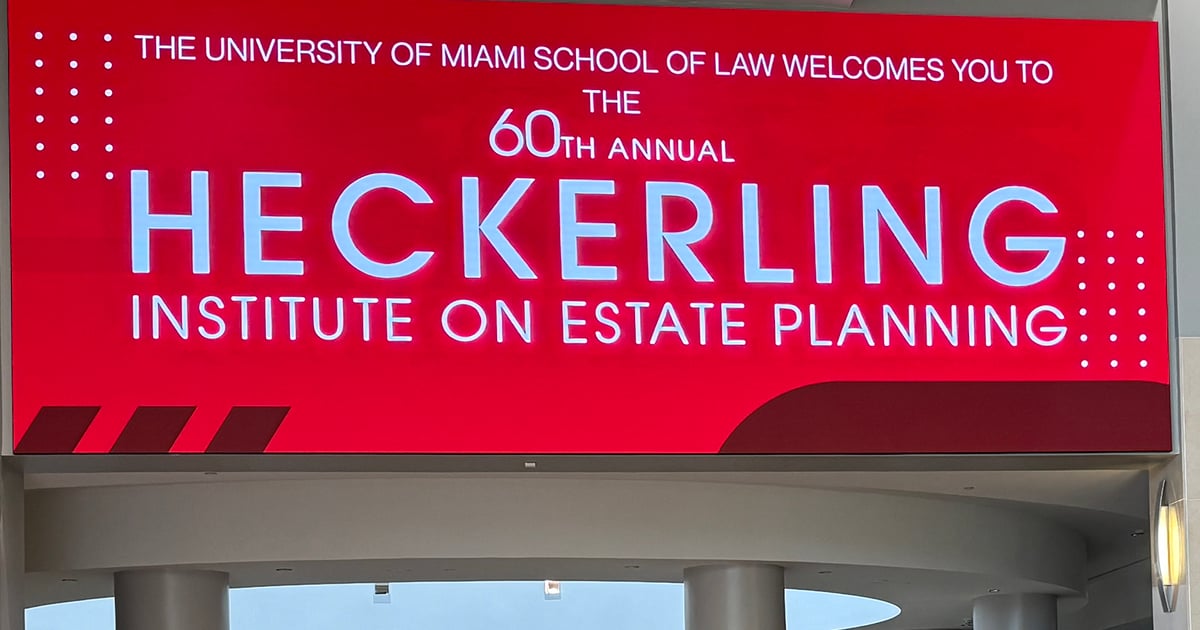
Key Takeaways from Heckerling 2026: OBBBA Implementation Issues
The speakers at the 2026 Heckerling Institute on Estate Planning covered a wide range of issues, including overlooked issues in the Old Big Beautiful Bill Act (OBBBA), planning opportunities with qualified small business stock, the importance of fiduciary duties and the need for offshore planning. Attendees had a lot of information to absorb. What were some of the key takeaways from the conference? We asked some of our editorial advisory board members who attended the conference to share their thoughts. Here’s what they said:
James Dougherty: OBBBA, Collaboration and Fiduciary Duties
The week provided those in the field much to reflect on and practical guidance to implement in their practices. With this being the first institute since the enactment of the OBBBA, various panels highlighted the impact of many overlooked provisions in the legislation. These highlighted that while high-net-worth individuals benefited from the increased exemption being made permanent, there were provisions that require thought and planning now. Some great presentations and materials gave advisors suggestions and examples of how they can help their clients in an OBBBA environment.
While the tax-focused presentations were excellent and naturally received attention, given that the field is still digesting what’s in OBBBA, the panels focused on duties and trust governance were fantastic and deserve focus. Benetta Y. Park, Paige Goepfert, and Lauren J. Wolven had an engaging panel discussion entitled “Making 1 + 1 > 2 – Keys to Effective and Ethics-Savvy Cross-Disciplinary Collaboration.” Clients are best served when their advisors work as a team to provide comprehensive, coordinated advice. In the presentation and their materials, each speaker explained how they see things through their respective professional lenses: attorney; accountant; and corporate fiduciary. Each of these perspectives have not only their own skill set to bring to the table, but also professional duties that must be respected. The presentation gave advisors a better understanding of their own responsibilities and appreciation of what obligations other advisors have.
Turning towards some presentations that focused on fiduciary duties. Phil Hayes gave an engaging summary of the evolution (and now devolution) of fiduciary duties in trust law, which was entitled “How Will the Trust Survive?” It covered how English (and its American progeny) law developed, in which those with legal title (the trustees) were bound by morality in the form of fiduciary duties. Phil contends that in the name of commerce and competition among the states, among other influencing factors, fiduciary duties have gone from requirements to default rules that can be contracted away. During this presentation and follow-up panel discussion, where he was joined by Carol Harrington, Lauren D. Hunt and Stefanie J. Lipson, the panelists explored an important question that’s perhaps not thought of enough or loudly enough with the background noise of states boasting how much their respective state’s law does away with fiduciary duties—Is it worth it? Does not having fiduciary duties improve outcomes, or does it normalize weaker standards? They certainly gave advisors something to ponder as they draft exculpation provisions and choose jurisdictions.
James Dougherty is a partner at Dungey Dougherty PLLC
Avi Kestenbaum: Recent Developments, QSBS Planning and Interests in Trusts
The Heckerling Diamond Anniversary Conference was very informative and enlightening as always. While each audience member, depending on their level of practice and experience, may have benefited differently from the excellent presentations, I want to highlight three that I found particularly helpful for those representing affluent clients in tax planning.
The Recent Developments presentation might be the most important and informative presentation each year. The distinguished panel of Samuel Donaldson, Carlyn McCaffrey and Turney Berry were outstanding. Professor Donaldson is funnier and quicker on his feet than any late-night comedian. Some very interesting and perhaps slightly controversial points were brought up, including the application of the Internal Revenue Code Section 68(g) limitations to non-grantor trusts and even trust distributions to beneficiaries being subject to the 2/37th haircut, and therefore, potentially subject to partial double taxation. Many were literally floored by this, including some experienced practitioners whom I spoke with after the session. They believed this couldn’t have been the intent of the statute. Hopefully, Congress, the Department of Treasury or the Internal Revenue Service will clarify this later this year. If not, it will be interesting to see how the tax preparation software for trusts will follow and compute this. Carlyn McCaffrey gave us some creative solutions, such as annually granting trust withdrawal rights to certain trust beneficiaries, including charities, and using S corporations (S corps) to avoid taxation at the trust level. Turney Berry raised some excellent practical concerns about the withdrawal rights.
To touch briefly on two other outstanding presentations regarding high level tax planning, Paul Lee brilliantly presented again on qualified small business stock (QSBS). Every tax planner should understand planning opportunities with QSBS. It’s perhaps the greatest gift in the entire IRC (maybe after life insurance). Every individual and entity that might qualify for the tremendous tax benefits of QSBS treatment, including converting limited liability companies, and S corps to C corporations should be exploring this. Paul pointed out the enhanced benefits under OBBBA, but more importantly (since many likely already know the new QSBS rules), several uncertainties of how QSBS applies in certain complex situations and ways to significantly increase these benefits. It was a terrific presentation even for those who are already frequently planning with QSBS.
Finally, Diana Zeydel, followed the next day by the panel of Diana, Jonathan Blattmachr and Todd Angkatavanich, gave us terrific and creative strategies for adding octane to planning with interests in trusts. There were so many different planning techniques and variations covered, and Diana and the panel covered them brilliantly from a technical, creative and practical standpoint.
Avi Z. Kestenbaum is a partner at Meltzer, Lippe, Goldstein & Breitstone, LLP
Joan K. Crain: Need for Offshore Planning
Although international topics occupied only two time slots during the week-long Heckerling Institute on Estate Planning—a 50-minute introductory session followed by a 90-minute deeper dive—Michelle Graham, conveyed an extraordinary amount of material in the session “Tax & Estate Planning for U.S. Persons with Global Investments.” Along with her panel, she presented the information in a way that was accessible to wealth planners who may not work daily in the cross-border arena but increasingly encounter clients with foreign ties.
Many international estate-planning presentations suffer from one of two flaws: They’re either so high-level that they lack practical guidance for most of the audience or so simplified that they offer little to the more seasoned international planners. Michelle’s presentations avoided both traps. She didn’t assume prior expertise, yet she didn’t oversimplify. As someone who routinely works on cross-border issues for clients of practitioners who are highly skilled domestically but understandably cautious about them, I found this approach particularly effective.
In her introductory session, Michelle explained complex concepts ranging from how to “own” property outside the United States. (the best solution to taking title is often counter-intuitive) to the perils of exporting a U.S. trust wholesale into another jurisdiction. Her insights into how the various marital regimes in different jurisdictions affect succession were also particularly valuable.
In the subsequent session, the panel did a deeper dive into a wide variety of issues. These included the importance of filing timely information reports such as Forms 3520, 3520-A, and FBARs; when it makes sense to have more than one will (another issue that often conflicts with typical domestic U.S. planning); and the rarely discussed but important topic of planning for disability when spending time abroad.
In summary, two key themes resonated through both presentations:
-
Global mobility and cross-border wealth are no longer niche concerns. U.S. persons with foreign structures are the norm, not the exception. Otherwise, “plain vanilla” estate plans may involve foreign bank accounts, offshore operating companies or inherited interests abroad. Advisors should assume complexity unless proven otherwise.
-
Engaging professionals outside the U.S. is critical. For American clients with global connections, the U.S. estate planner and tax advisors must work in close coordination with foreign counsel and related advisors.
Michelle Graham’s sessions provided an efficient, well-designed introduction to these realities and, just as importantly, modeled how complex international topics can be communicated clearly to clients and fellow advisors. The presentations equipped planners to recognize when a fact pattern has crossed into international territory, and when instinctive, U.S.-centric solutions may lead to unintended consequences.
In a conference filled with excellent content, these international sessions stood out because they addressed an area where many advisors feel least confident, yet increasingly exposed.
Joan K. Crain is a Global Wealth Advisor with J Crain Consulting
Al W. King III: Trust Situs Conflict of Laws
Another great year at Heckerling, with several interesting sessions and updates. I found the session entitled “Do you know where your trust is sited?” to be particularly interesting and extremely important.
The session dealt with the conflict of laws issues associated with the popular strategy of naming a trustee in another state, mainly by changing trust situs and/or decanting. The session addressed many of the potential issues associated with interpretation, construction, validity and administration. The latest drafts of the Uniform Conflict of Laws in Trusts and Estates Act as well as the Restatement (Third) of Conflict of Laws were also discussed.
The session laid a great foundation. The topic raises many questions regarding several closely related and overlapping topics, such as state income taxation, asset protection, investment management fees unable to be deducted as trust administration, custody and the impact on trust duration (for example, the rules against perpetuities). All these issues are extremely important as trust situs planning continues to gain in popularity and becomes a routine part of estate planning.”
Al W. King III is co-founder, co-chairman and co-chief executive officer of South Dakota Trust Company
Joy Matak: 2/37th Limitation and the Income Distribution Deduction
The Tax Cuts and Jobs Act (TCJA) suspended most miscellaneous itemized deductions for tax years 2018-2025. The TCJA left a carve-out for trusts and estates, permitting fiduciaries to deduct expenses “which would not have been incurred if the property were not held in such trust or estate,” such as commissions and fiduciary tax preparation fees (Internal Revenue Code Section 67(e)).
The One Big Beautiful Bill Act (OBBBA) made the suspension of itemized deductions permanent and further reduced allowable itemized deductions by 2/37th of the lesser of:
-
“The amount of itemized deductions, or
-
So much of the taxable income of the taxpayer for the taxable year … as exceeds the dollar amount at which the 37 percent rate bracket [ ] begins.”
The Recent Developments panel theorized that because of the way that OBBBA was written, income distribution deductions may be subject to the 2/37th limitation. Non-grantor trusts are generally eligible to deduct income distributed to a beneficiary in determining taxable income. The panel pointed out that Congress explicitly exempted specific deductions from the 2/37th limitation without excluding the income distribution deductions. As a result, income distribution deductions are allowable itemized deductions subject to the 2/37th limitation. During the Questions & Answers session, the panel delved into the risk that applying a 2/37th limitation to an income distribution deduction would likely result in double taxation because the beneficiary would be required to report and pay taxes on income distributed by the fiduciary. While the panel acknowledged that Congress probably didn’t intend for this result, practitioners may be stuck with it until a technical correction is issued.
As a workaround, the panel suggested that granting a withdrawal power to a beneficiary could perhaps avoid the 2/37ths limitation:
-
To qualify for qualified terminable interest property treatment, consider granting the surviving spouse a power to withdraw all accounting income generated by the trust not less often than annually.
-
A discretionary trust might empower a fiduciary to identify a portion of the trust income or principal eligible for withdrawal by one or more beneficiaries each year.
-
The panelists warned that limiting a beneficiary’s withdrawal power by an ascertainable standard would likely prevent grantor trust treatment as to the beneficiary.
From a fiduciary income tax perspective, granting the beneficiary a withdrawal power would split trust income so that income subject to the withdrawal power is taxed directly to the beneficiary, who would be deemed the owner of the income. The trust would never be taxed on distributable income, thereby avoiding the 2/37ths limitation.
Joy Matak is a partner at Avelino Law LLP