
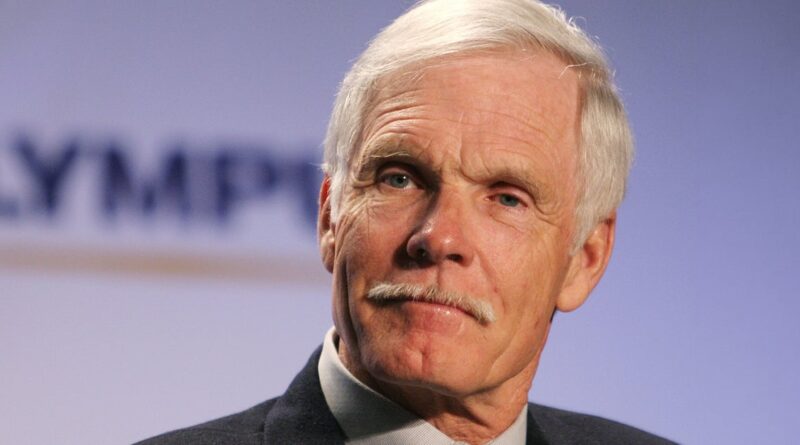
Ted Turner’s Death Raises Questions About His Legacy
The recent passing of media mogul and CNN founder Ted Turner, at age 87, has shone a light on his life and philanthropic work, while sparking questions about how his heirs will preserve his legacy.
Building a Media Empire
Turner amassed his fortune in the media industry that transformed how Americans consumed news and entertainment. In 1980, he launched CNN, the world’s first 24-hour cable news network, a concept many industry experts initially dismissed as impossible. Turner continued expanding his media empire with TNT, Turner Classic Movies and the Cartoon Network. He cemented his billionaire status after the 1996 sale of Turner Broadcasting System to Time Warner, valued at $7.5 billion. Although his wealth declined significantly after the disastrous AOL-Time Warner merger in 2000 due to the dot-com bust, Turner remained a billionaire throughout his life, with an estimated net worth of approximately $2.2 billion at the time of his death.
Ted Turner’s Estate
Turner’s wealth is primarily composed of vast rural land holdings, remaining media investments and legacy business ventures. Turner is one of the largest private landowners in North America. His fortune is heavily rooted in the ownership of approximately 2 million acres of ranchland across the U.S. and Argentina. His diversified business assets include a stake in the Ted’s Montana Grill restaurant chain, which he co-founded in 2002.
Who Will Inherit Turner’s Estate?
Turner’s estate is divided among his five children from his first two marriages: Laura Turner Seydel and Robert Edward “Teddy” Turner IV from his marriage to Julia Gale Nye, and Rhett Turner, Beauregard “Beau” Turner and Jennie Turner Garlington from his marriage to Jane Shirley Smith. Turner was also married to actress Jane Fonda from 1991 to 2001, though they had no children together.
The Turner children have largely maintained lower public profiles than their famous father, though several have been involved in environmental and philanthropic causes. Laura Turner Seydel has been particularly active in environmental advocacy through the Captain Planet Foundation. The children now control the board of directors of the Turner Institute of Ecoagriculture and oversee Turner Enterprises, which manages the family’s extensive land holdings across multiple states. Turner also has 14 grandchildren and two great-grandchildren, who may eventually inherit portions of the estate. The specific details of how Turner’s estate will be distributed among his heirs, charitable foundations and non-profit organizations remain private, though his Giving Pledge commitment suggested the majority would ultimately support charitable causes.
A Lasting Legacy
Turner dedicated his life to philanthropic causes, including funding large-scale conservation and ecosystem restoration, such as the preservation of the American bison, which had been hunted to the brink of extinction.
In 1997, he made what was then believed to be the largest single charitable gift in history: $1 billion in Time Warner stock to support United Nations programs, more than a third of his wealth at the time.
The donation came after Turner learned that the United States was approximately $1 billion in arrears on its United Nations dues. Because the U.N. couldn’t accept donations directly from private individuals, Turner created the U.N. Foundation.
In 2010, Turner became a signatory to the Giving Pledge, committing to donate the majority of his wealth to charitable causes.
His philanthropic portfolio included the Turner Foundation for environmental conservation, the Captain Planet Foundation, the Turner Endangered Species Fund, the Nuclear Threat Initiative, co-chaired with former Senator Sam Nunn, and the Turner Institute of Ecoagriculture (the Institute), which researches sustainable ranching practices.
A Promise Without Binding Power
In 2021, Turner made headlines when he donated the 80,000-acre McGinley Ranch in Nebraska to his non-profit organization, the Institute, while publicly pledging that it would continue paying property taxes despite its non-profit status. “I believe that local property taxes provide essential support for services on which our ranchers and communities depend,” Turner stated at the time. “The Institute will continue to pay its share of taxes to support the local communities.”
However, Turner’s death has now raised uncertainty about the future of that promise. There’s no binding mechanism to enforce this promise. Its enforceability now rests with his family and the nonprofit’s board.
“Promises that aren’t documented in a binding contract are generally not enforceable, and for the Turner Institute, this means its board should be able to revisit its prior promise to pay property taxes even though it could have applied for an exemption,” explained Sean R. Weissbart, Partner and Co-Chair of the Tax, Benefits, and Private Client Practice Group at Blank Rome. “The board will now likely have to weigh honoring the word of its founder against whether its resources are better used paying taxes or through new programming in furtherance of its mission,” he added.
The Estate-Planning Gap
Turner could have established contractual provisions requiring property tax payments as a condition of the transfer or created trust structures with specific mandates that would bind his successors for a defined period. He could have negotiated payment-in-lieu-of-taxes agreements with local governments, creating legally enforceable obligations. Instead, his verbal commitment, however sincere, carried no legal weight after his death.
This gap between intention and execution represents a cautionary tale for estate planners and philanthropists. Even billionaires with access to the finest legal counsel can leave critical commitments unenforceable if they rely on goodwill rather than binding legal structures.
The Unanswered Question
As Turner’s family assumes control of his vast land holdings and non-profit organizations, they face a defining choice that will shape his legacy. The Institute and Turner Enterprises haven’t publicly commented on their intentions regarding the property tax commitment since Turner’s death.
Whether Turner’s word and his vision of supporting rural communities will endure remains one of the most significant unanswered questions of his remarkable legacy. For estate- planning professionals, it serves as a powerful reminder that even the most generous intentions require careful legal structuring to survive beyond a donor’s lifetime.